Postby roninsoldier83 » Wed Nov 26, 2008 9:14
On my former Speed6, I ran a single exit CP-E cat-back, and can only say it sounded phenomenal. I liked the fact that it was a full 3", and single exit, as IMO, dual mufflers on a turbo 4 cylinder are for nothing more than looks. Although, I left the stock metal rings in bumper, so unless someone was looking closely, it still looked like the car retained dual exhaust.
Me personally, unless you really just like looks, I never saw much of a reason to run a dual exhaust on a turbo 4 banger. The exhaust manifold comes to a single collector point, where it connects to the turbine housing. On the back of the turbine housing, a single downpipe is connected lol. Going back, there's really no reason to branch it off into a y-pipe (especially is the y-pipe branches off into 2 smaller diameter pipes), as a properly sized single exit exhaust would be the most efficient way to route exhaust. Not to mention, you save the weight of having a second muffler.
With my old CP-E, to give some background, I had a gutted stock DP + test pipe, so there were no cats left on the car... either way, I saw negligible gains if any real gains at all. Honestly, on a turbo car, the added back pressure of a restrictive exhaust, to include cats, baffled mufflers, unnecessary resonators ect, are never a good thing. As the turbine housing/turbo is exhaust driven, the same rules that apply to naturally aspirated cars do not apply on a turbo car.
Freeing up exhaust back pressure, will allow the turbo to spin more freely, as well as take down your EGT's, which, high EGT's can lead to substantially reduced turbine life & make your turbo have to work harder to produce the same boost pressures. I must add though, that if you really want to see any substantial gains from a cat-back, you must eliminate the first restriction(s) in the exhaust system, namely the downpipe. If you're bottle necking the exhaust right after the turbine housing, which is evident when you look at the substandard wall & plate style mouth on the stock downpipe, realize a freer flowing exhaust AFTER that is not addressing the most restrictive portion of your exhaust, hence you will see minimal gains.
Now, get a good bellmouth or divorced wastegate DP in place of the stocker, eliminate both of the factory cats, while keeping the piping the same diameter all the way from the DP back... THEN add a free flowing cat-back, and there's when you might actually start to see a noticeable gains. I made the mistake of just gutting my stock DP, which yielded a whopping 3whp on MAC's dynojet... this was NOT the ideal way to bring down EGT's, and take down exhaust turbulence. As the stock DP tapers sharply right before the cat, then even with the cat gutted, you create a huge expansion chamber which tapers sharply right after... I have no doubts in my mind that a well designed aftermarket DP would have resulted in larger gains. Probably a good reason why I didn't hardly see any power gains from a 3" exhaust like CP-E.
Whereas in contrast, I had my STI dyno tuned with only a Cobb downpipe & pulley, running the stock exhaust.... then later had it retuned with only the addition of a Borla XR-1 cat-back exhaust & K&N panel filter.... with the added exhaust, the piping went from 2.5" to 3", it eliminated a resonator, and the muffler went from a baffled muffler to a more straight through type design (Borla's XR-1 design has an interesting 3-pipe design inside, more free flowing than stock for sure). The results? An extra 10whp & 26 ft-lbs of torque. That was with the same WGDC's & AFR's. Looking at a boost graph, it was easy to see where the new found power came from... while the car was still hitting about the same peak boost pressures, although you could see it wasn't tapering off as bad as RPM's went up, which could only be attributed to less exhaust turbulence/back pressure with the freer flowing exhaust, increasing the turbine housing's overall efficiency level. I.E. turbine housing was able to hold more boost up top without touching the WGDC's or peak boost settings.
I digress from the point I was trying to make.... if you want peak power potential, to include the area under the curve (which IMO, is just as important as peak power, if not more), I would advise picking up a full 3" TBE. If you had an EGT gauge, you would be astounded at how much it would take down your EGT's, helping your turbo to operate at a higher efficiency level. That's just my $.02
AKA- [color="Blue"]arctic_blue83[/color]
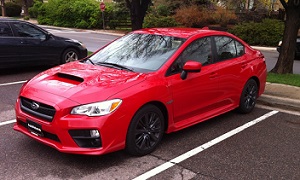
Mine: 2015 Subaru WRX
Hers: 2013 Subaru WRX



 Though, he did back off before I did and disappeared in traffic.